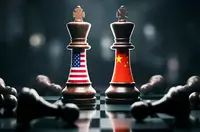
In the new multipolar world, we see the economic and military power blocks — the US and China, Europe and Russia - as the global winners dividing up the world between them. Trump's America is laying claim to the Western hemisphere. China is extending its influence along the old Silk Road and into Africa, while Russia is seeking to recapture the Soviet empire. But the story is less clear-cut. Iran and Ukraine have demonstrated the limitations of the great powers. Taiwan controls production of the world's most advanced semiconductors. Egypt, 30% of the world's container traffic. Nigeria will have the third-largest population in the world by 2050. India, the world's largest economy by 2060. Half the world's trade is outside the major power blocks.
Is the idea that superpowers rule the world a fairytale? Should we see in the fragmentation of power a world of danger? Or is a world with many sources of power one of potential and a shared future?
Former President of the UN Security Council Kishore Mahbubani, former Chancellor Kwasi Kwarteng, and former leader of Ireland Leo Varadkar debate power and the multipolar world.
 This event is only accessible with a Festival Ticket - there are no individual Event Tickets


